One of the best things about getting back into the hobby was reading back through my old White Dwarf magazines.
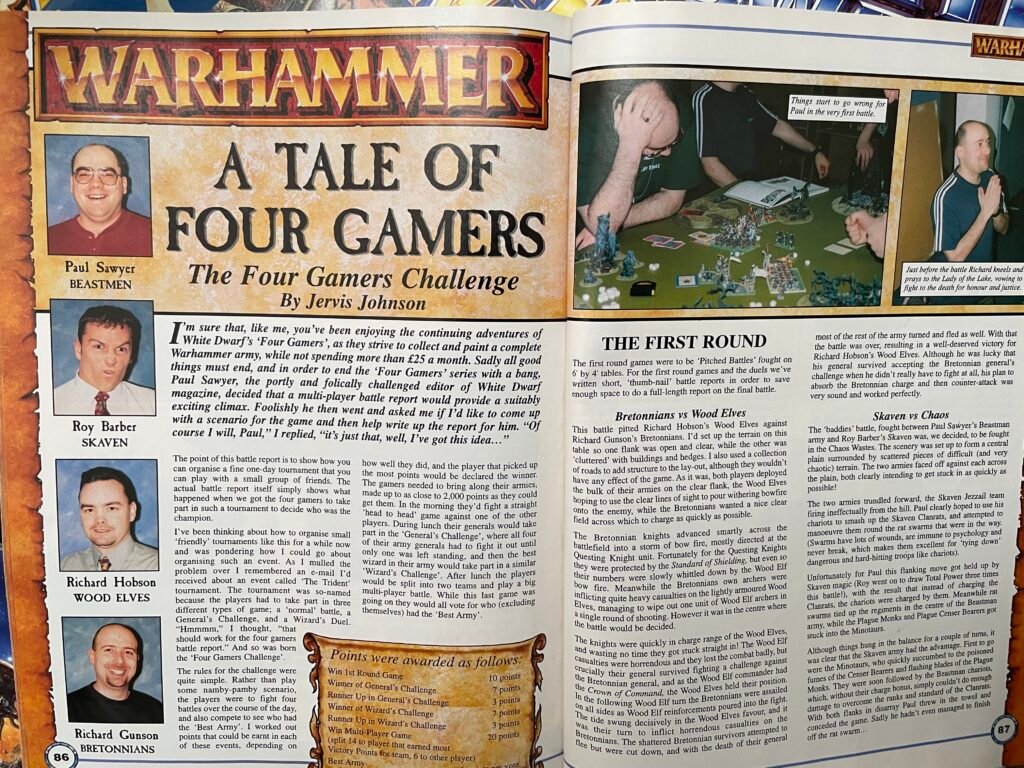
My collection spans from late 1993 to mid-1998, and one of the most loved and fondly remembered features of this period was “A Tale of Four Gamers”.
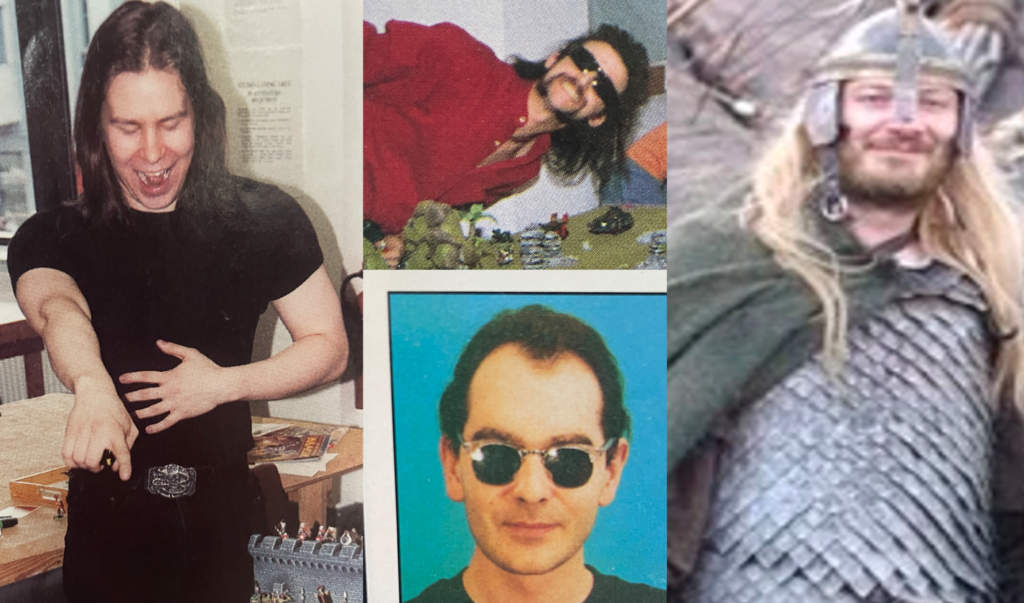
The concept of A Tale of Four Gamers was simple but effective. White Dwarf took four Games Workshop staff (Paul Sawyer, Richard Hobson, Roy Barber, and Richard Gunson) from different parts of the company, gave each of them a small monthly budget, and had them build, paint and eventually battle with a Warhammer army entirely in public view through the magazine.
It ran for five months in 1998. Fifty quid to start, then twenty-five a month after that, working out at £150 total by the end*.
Nobody was told what to buy or how to paint it, so all four ended up going in completely different directions: Roy Barber built Skaven, Richard Hobson did Wood Elves modelled on Robin Hood, Richard Gunson went Bretonnian, and Paul Sawyer (AKA Fat Bloke) painted Beastmen almost entirely in metallics.
The whole point was showing the process honestly, budgets, mistakes and all, rather than just presenting a finished army under studio lighting. That’s what made it feel achievable to readers in a way most hobby features at the time didn’t.
Sean recently reached out to say he was running a series of deep-dive videos on A Tale of Four Gamers, the first of which earned him an enthusiastic YouTube comment from none other than Richard Hobson.
Sean took the opportunity to reach out to Richard, which led him to get in touch with Richard Gunson and Roy Barber as well. Tragically, Paul Sawyer passed away last year – he was only 59.
The trio were keen to talk to Sean about A Tale of Four Gamers, and he jumped at the opportunity to get them together for an interview that he could use for the final video in his series. He was looking for a little backup on the tech/recording side, and I was only too happy to help. It was a fascinating conversation to sit and listen to, and I’m delighted that Sean has allowed me to play it in full now on this episode of the Tabletop Miniature Hobby Podcast.
*Sean reckons that £150 budget is roughly £300 in today’s money.
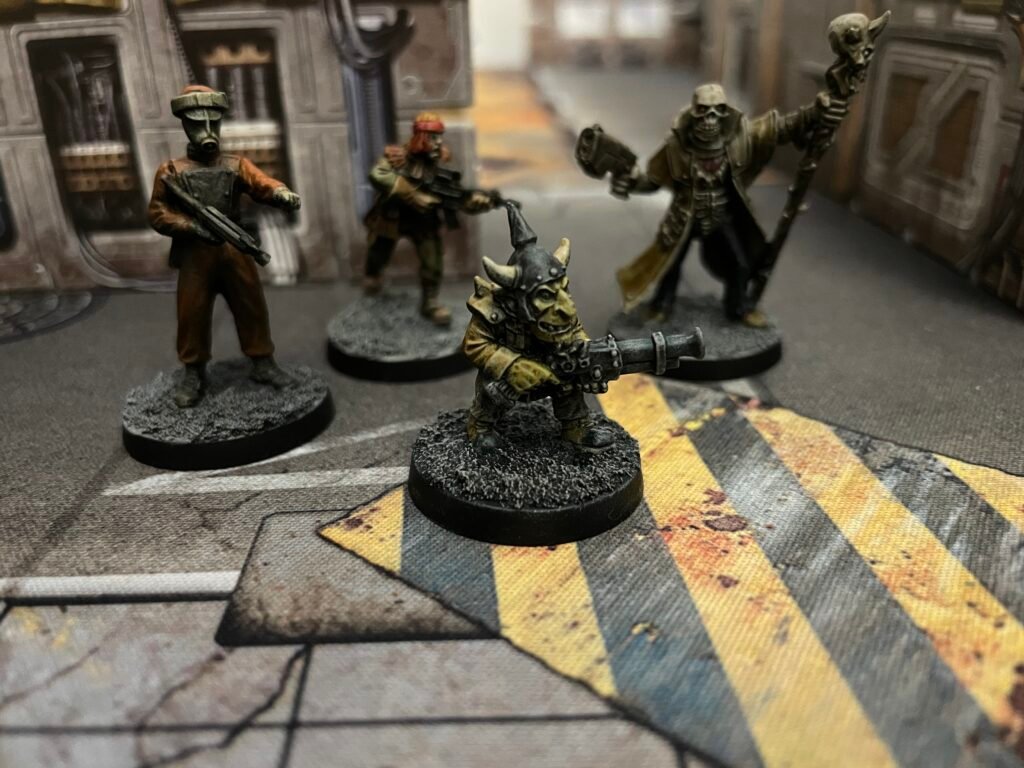
Four against seven. Dante, Cook, Dust and Tinhead were all Old Reliable had left to throw at the raiders now picking through her hold, and there was nowhere on that ship to hide from what was coming.
It started well. Dante caught one of them clean through a gap in the crates, Dust dropped their specialist before he’d even drawn his gun, and a third raider lost his nerve entirely and bolted somewhere into the bowels of the ship, presumably to hide in a cupboard until it was all over.
For a moment, against all odds, it looked like the Lucky Strikes might actually hold the line.
It didn’t last. The raiders found their second wind just as the Strikes were running out of road, and from there it fell apart fast. Dante was cut down by the lieutenant’s clingfire pistol. Tinhead went next, torn apart in the crossfire, and then it was just Cook and Dust, pinned behind whatever cover the corridors offered, trading shots with raiders who kept on coming no matter how many went down.
Cook held out as long as he could before the lieutenant finished him too, and by the time it was down to Dust alone, more raiders were creeping out of the ship’s hidden corners to replace every one he dropped. He took out the one who’d killed Tinhead, for whatever that was worth, before the lieutenant closed the account for good.
Every credit gone. The stash stripped bare. And all four crew members taken out.
Is this the end for The Lucky Strikes?
After the Storm
Dust survived, just, though not without cost, a wound serious enough to leave him permanently slower than he used to be.
Cook got off lightly, a knock that’ll keep him in the sick bay a turn, but nothing worse.
Tinhead’s blast rifle was wrecked beyond use, though the old bot himself walked away untouched.
But Dante, whose luck had run out once before and been spared by the skin of his teeth, wasn’t so fortunate a second time. The captain of the Lucky Strikes didn’t get up.
With no credits left to pay anyone’s keep, and every fit crew member either dead, injured, or still recovering from Valtherus, there was no version of the next turn that didn’t end here.
The Lucky Strikes are done.
Dante Corsaro lay bleeding out on the rusty floor of his ship, Old Reliable. All around him, greedy cutthroats tipped out boxes and drawers, filling their pockets with his crew’s hard-earned gains.
He never imagined it ending this way. Dante was always a man who walked off the set on his own terms, much like Barry Gibb on the Clive Anderson show back in 1997.
“Alexa,” he groaned through bloodied lips, before giving his final command as the captain of the Lucky Strikes: “play Tragedy by the Bee Gees.”
The song starts. Dante’s eyes glaze over as he imagines the ship’s flashing warning lights as glittering disco balls. “We’re getting on like a storm, aren’t we, Clive?” he mutters, falling into delirium.
A nearby raider – coincidentally called Clive – overhears him. He shrugs, points his gun at Dante’s head, and the world goes black.
And that’s it for the Lucky Strikes. But what a journey it has been.
And it’s not the end of the story entirely. Cook, Tinhead, Jaryn, Tace and Dust all survive, battered and scattered as they are, and there’s every chance they’ll turn up again down the line, whether as the seed of a new crew or just familiar faces in a future adventure. But for now, rest in peace, Dante, and rest in peace, the Lucky Strikes.
Next time, a change of scenery: a new diary, a new setting, and a warband setting out into Five Leagues from the Borderlands. Introducing… Jeff’s Stag Party.
As the door closes on my first Five Parsecs From Home campaign, I’m excitedly prepping for my debut playthrough of its fantasy sister title, Five Leagues From the Borderlands.
The first step is to swap out some terminology. It’s not a crew now; it’s a warband. Though in this instance, it was intended to be more of a party.
Because how could I not build that warband around Bedroom Battlefields community mascot, Jeff, the wandering wizard?
And what better reason to assemble a band of brothers around Jeff than to celebrate his stag do?
It’s impossible to tell where or when Jeff will be tying the knot. But we can safely assume there’s at least one version of him out there right now gearing up for the big day. And you can’t have that big day without first going out for a couple of pints with the lads.
In true Jeff fashion, though, nothing has gone to plan. They have a table for six reserved in Bugman’s Bar. But Jeff’s “book six seater taxi” spell has failed somewhat spectacularly, and the party finds themselves transported to an unknown location in the bleak wilderness.
The big picture goal is to get to the pub in time for their booking. But they may face a more immediate challenge of staying alive. With that said, there seems to be the opportunity to gather some gold, glory, and adventure in the process. It could make for some great post-dinner speeches at the wedding, assuming they survive.
The warband (or, party)
So, who are the six members of my warband heading into the first campaign turn? Let’s introduce them.
Jeff (Mystic)
The man, the legend. This multiverse-spanning character (a print of the original 1995 Warhammer Quest wizard) pops up everywhere trouble is found, finding himself lost on sprawling 24ft by 6ft tables, turning monarchs into mallards, or stepping through portals into the goblin green-coloured future of the 41st millennium. He’s getting married. But first, he just really wants a pint with the boys.
Grubb (Avatar/Hero)
This sinister-looking ranger is Jeff’s best man, as well as his odd jobs man. Grubb is top of the list if Jeff ever needs anyone murdered, intimidated, or interrogated. However, he’s also a keen interior designer and passionate believer in feng shui. Jeff regularly hires him to arrange the living rooms in his tower, and the tower’s east wing is, as a result, extremely well balanced energetically, if a little heavy on water features.
Hector (Hero)
A few years ago, Jeff was ambushed by highwaymen on a quiet country road. Amused, he cast “delete clothes” on their leader, a large burly chap with a spear. It was a bitterly cold afternoon, and his colleagues didn’t much fancy the look. They scattered back into the trees, leaving their leader standing there holding one very large weapon, and staring down open-mouthed at one pitifully small one.
Jeff thought little more of it as he rode off, laughing to himself. That was, until last year. The same man – still naked as the day he was born – turned up at Jeff’s tower to beg for him to “lift the curse”. Apparently, Jeff’s spell had (surprise surprise) gone a bit wrong, and the man had never since been able to put on so much as a sock without it immediately vanishing into the ether.
Of course, Jeff had no idea how to fix this, so he convinced the man to rebrand himself as an exiled tribal chieftain from Albion. It was, frankly, an appalling solution, but he couldn’t think of anything better. In the end, Jeff felt a bit guilty about the whole thing and agreed to hire “Hector”.
Certainly, no one else would.
Goatsy (Hero)
Goatsy is a beastman outcast who was excommunicated by his herd.
It all started when he found a mysterious eldritch wood carving of two huge hands pulling open a vast portal. Baffled, he showed a few of his friends, who seemed to visibly reel in horror at the image.
Goatsy initially found this reaction annoying and frustrating. He couldn’t get anyone to tell him what was wrong. They simply didn’t want to look at it. They even went as far as to call him “disgusting”, and chide him for “taking it too far”.
But eventually, he began to have fun with it. He’d hide the carving in caves, crates, and burlap sacks.
“Hey, Krull, pass me a femur to gnaw on” he piped up with a smirk one evening. Krull howled in outrage as he pulled the carving out of the bone pile.
The next day, Goasty was summoned in front of the herd’s head of HR and informed that his services were no longer required. That afternoon, Jeff found him sitting miserably by the side of a road. He asked him if everything was okay, and Goatsy told him the full story.
“Can I see the carving?” Jeff asked.
With trepidation, Goatsy held it out for him. Jeff howled with laughter, and said, “You’d better come with me, son.”
Baffies (Follower)
Baffies is a disgraced former court jester who turned out to be a notorious serial killer and cannibal. He’d entertain his Lord’s guests with feats of juggling, firebreathing, and side-splitting comedy routines. Then, he’d drug their wine and eat them for his supper.
One evening, Jeff found himself dining at this particular manor. He was enjoying the entertainment immensely, though the events of the day were clearly catching up with him. He felt groggy, and excused himself to retire to his room, barely making it to bed before falling into a deep sleep.
He awoke some hours later to find himself lying on an old butcher’s slab in some dank chamber in the servant’s quarters. He looked up to see a shocked-looking jester wearing a bib, and holding a knife and fork in his hands.
The pair had a right good laugh about it, and have been close friends ever since.
Harkel (Follower)
Harkel is a troubled former soldier turned cauliflower farmer. In the midst of a particularly depressing midlife crisis, he decided to shut up shop and travel north to the chaos wastes, inspired by the sudden ambition to become a greater daemon.
He almost got there, too. In fact, it was on the very fringes of those warp-addled lands where Harkel bumped into Jeff, coming the other way. Jeff was shoeless, eating a bucket of fried chicken, and his beard was slightly smouldering as if it had recently been on fire.
“I just met you in sixty years”, said Jeff, as if they were two neighbours passing one another in the street. “Doesn’t end well for you. A particularly woeful-looking spawn…”
If Harkel had thought Jeff as mad as a box of frogs, he’d have been right. But something in Jeff’s eyes told him he was right, too.
Jeff put an arm around Harkel and led him away, back south towards civilisation.
Just like my Five Parces From Home Diaries, I’ll be documenting my Five Leagues campaign in podcast form on the Bedroom Battlefields Patreon!
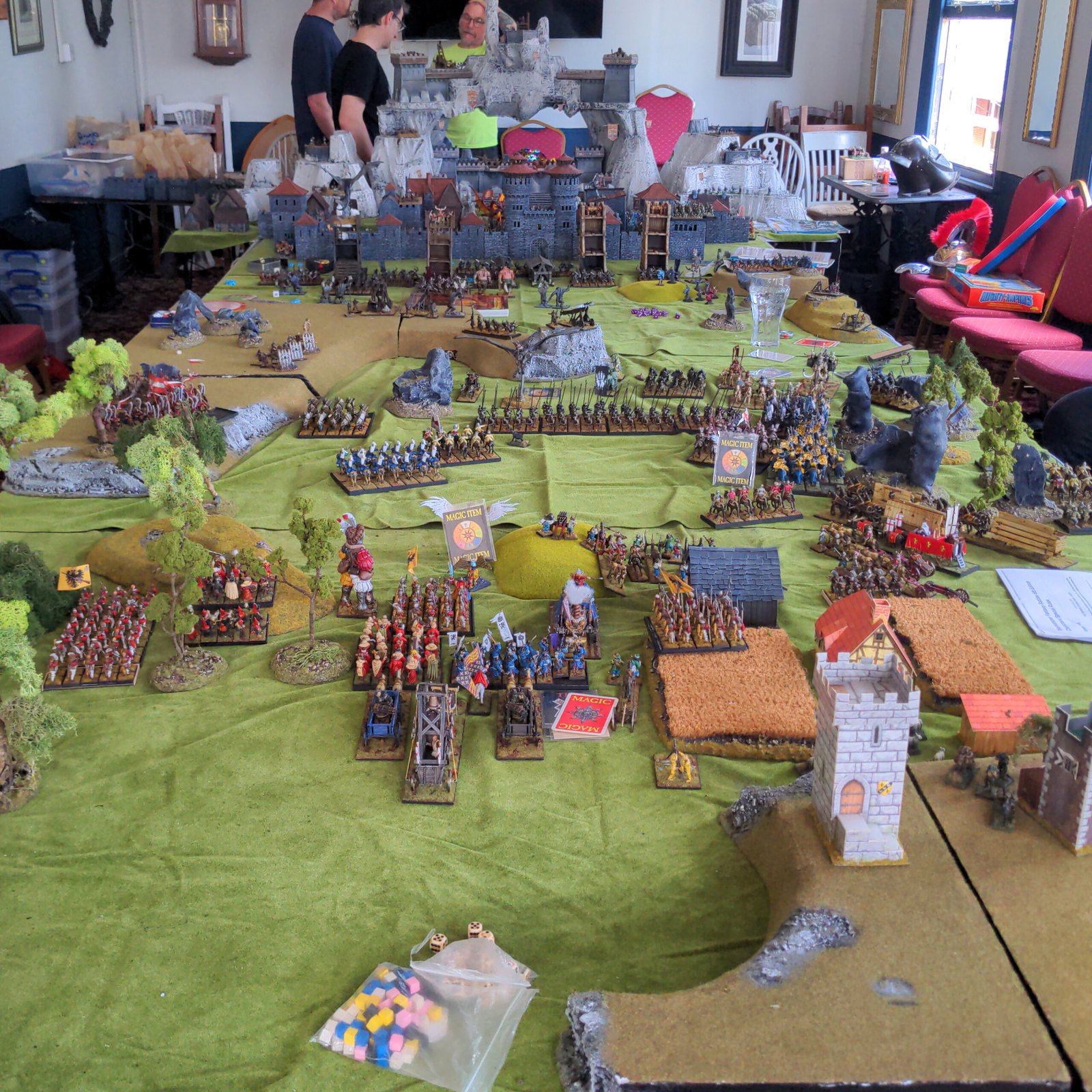
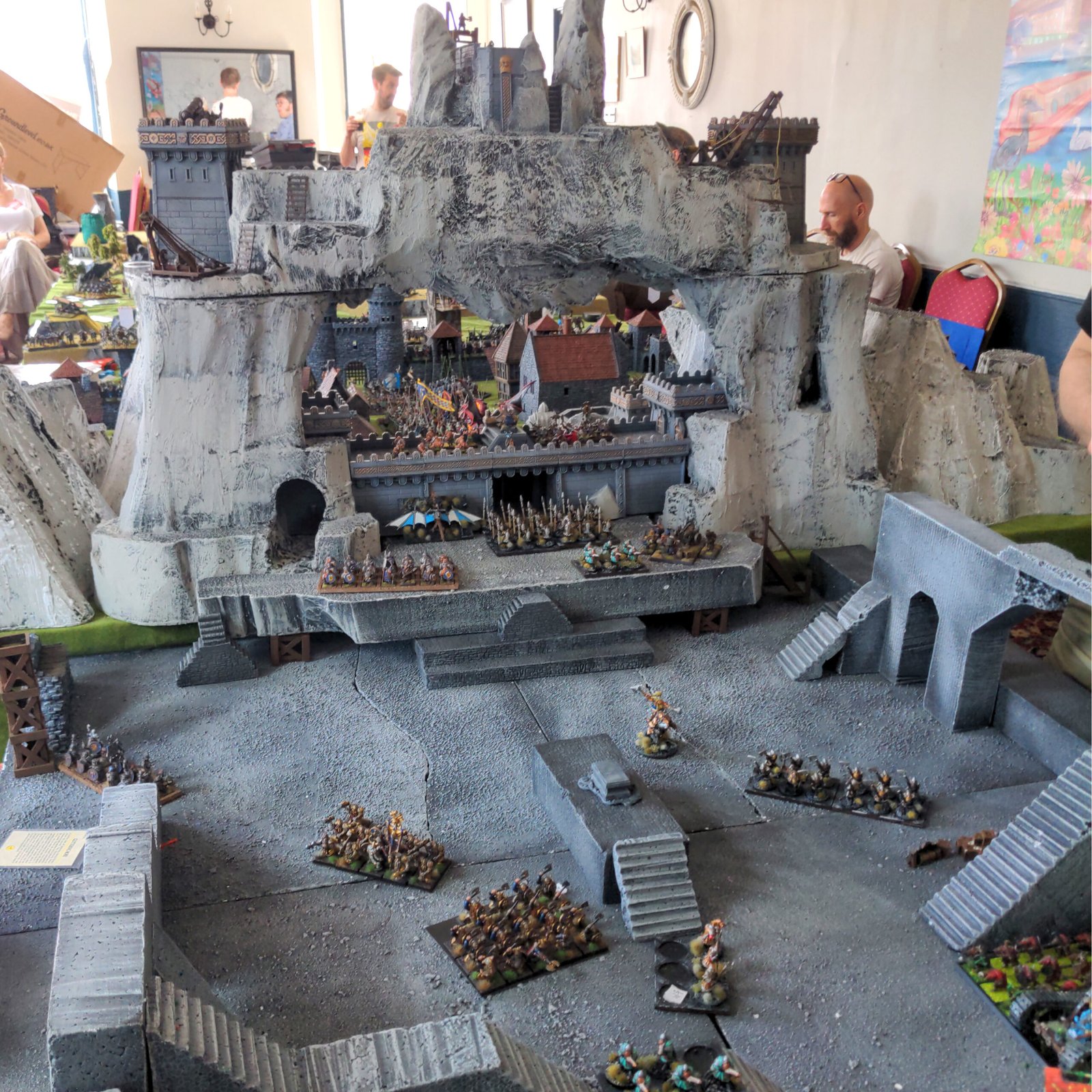
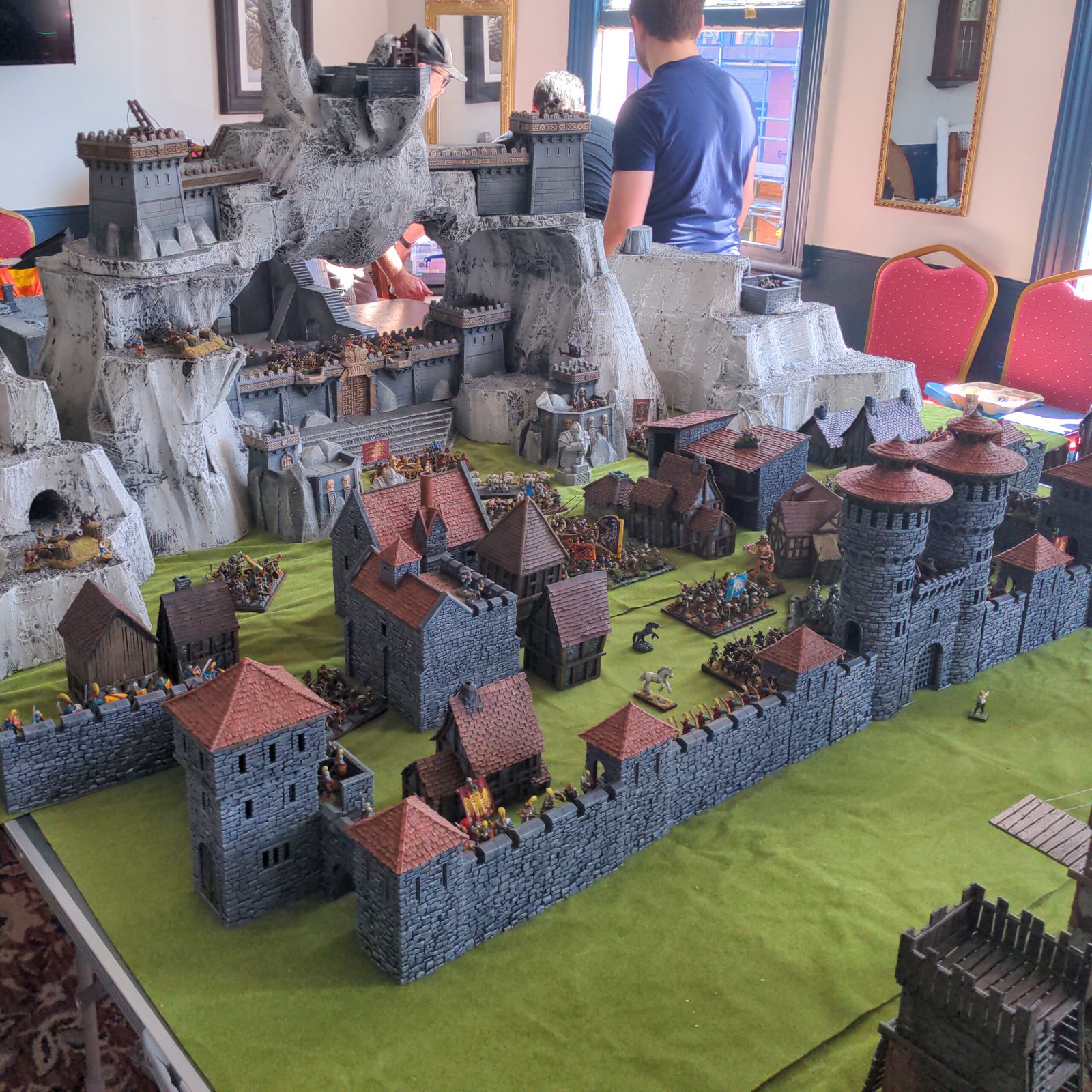
With Bring Out Your Lead falling through this year, a determined crew decided the show would go on regardless. Jason had a huge narrative Warhammer Fantasy campaign ready to hit the table, so rather than wait, the group arranged a room above a pub in Nottingham, dubbed the event BOYL Gits, and got on with it.
And what a table (twenty-four feet by six!!) staging the Siege of Karak Spork in full. (Thanks to Doctor Spork for the photos)
Or just search “Tabletop Miniature Hobby Podcast” in your listening app of choice!
Jason’s mountainside and mine dominated one end, Calum turned up a striking 3D-printed assault fortress knocked out in just twelve hours (with help from Stuart, who drove hours just to lend a paintbrush for the afternoon), and Ben’s painted human settlement, dropped off before he flew out to Peru, filled the space in front.
The whole thing split naturally into three separate scraps: a siege at the gate, an inner-hold fight, and a relief force pushing across open ground, all painted to a standard the lads clearly took real pride in. One block of a hundred or so pikemen got singled out as a highlight in its own right.
Plenty of good chaos followed: undead cavalry running amok, a stolen Skaven steam tank going spectacularly out of control and taking out a chunk of wall along with a wyvern rider, and Nagash putting Orion firmly in his place after a duel running to eight rounds of combat.
These showcase games are becoming a real fixture for the Bedroom Battlefields community. If you fancy getting involved in the next one, come and join us on Discord, that’s where it all gets planned!
Also… GenCon!
The second part of the episode features another event report, this time from GenCon 2026. Rob Dean was there, and he also has a write-up and a load of great pictures over on his blog, The Sharp End of the Brush.
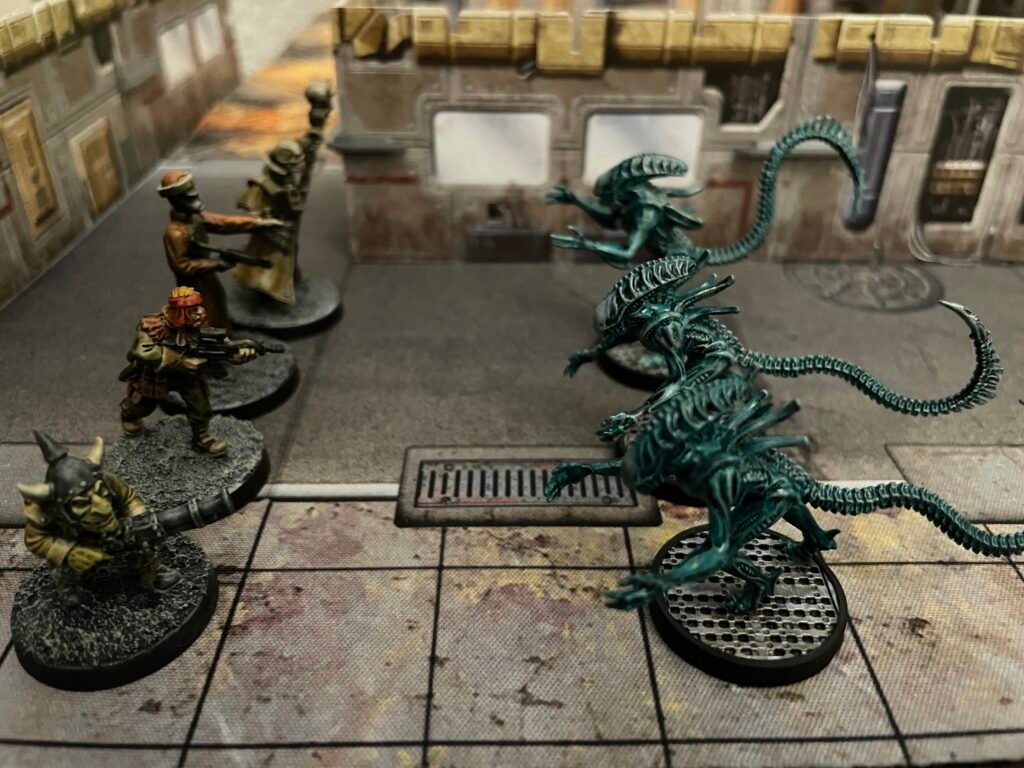
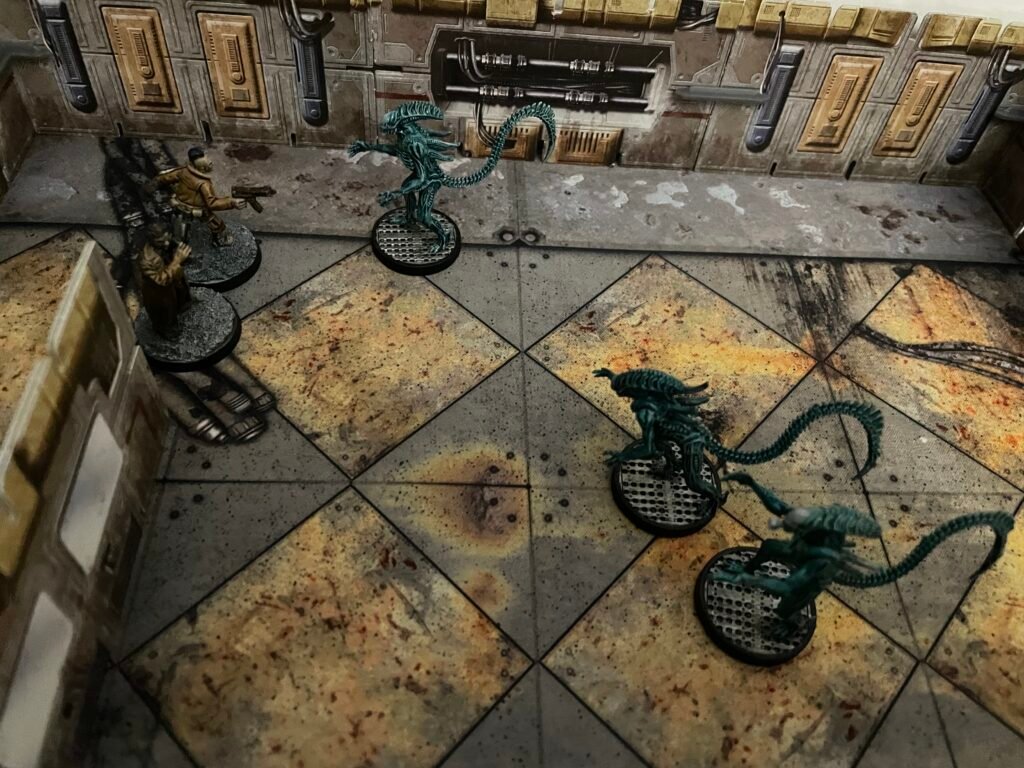
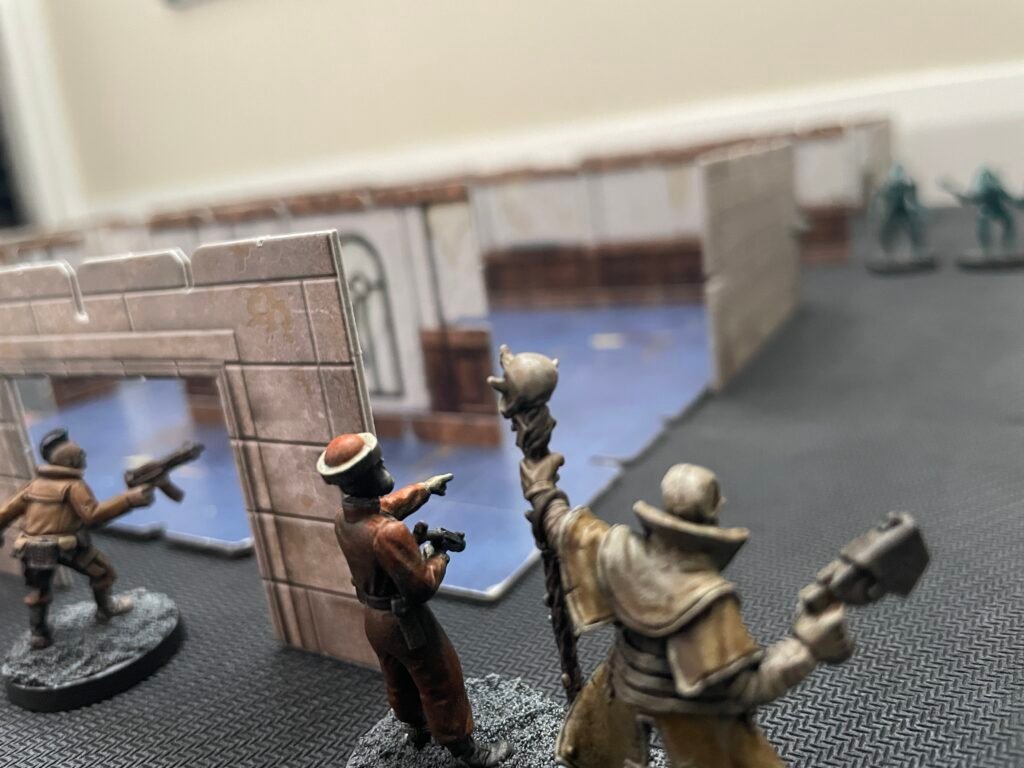
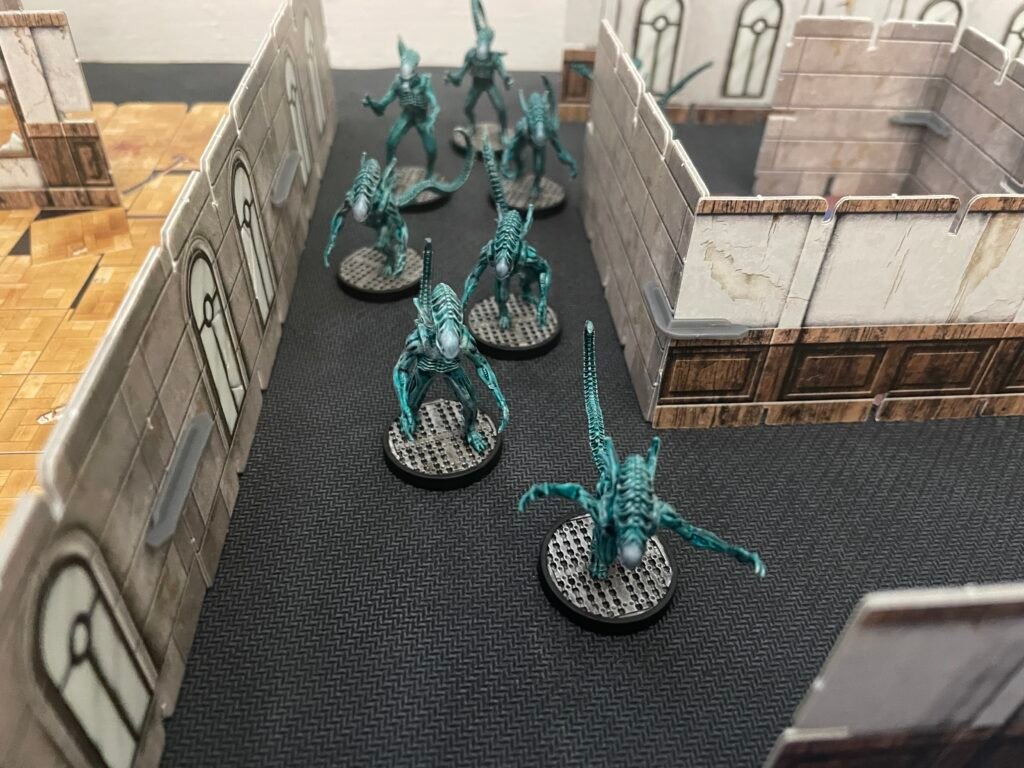
The Lucky Strikes’ cue to leave Valtherus was a government announcement declaring a state of emergency. The xenomorphs unleashed in the theatre’s basement had, it turned out, been only a taste of things to come, and the planet’s major cities were now teeming with the creatures.
The Swarm Brood
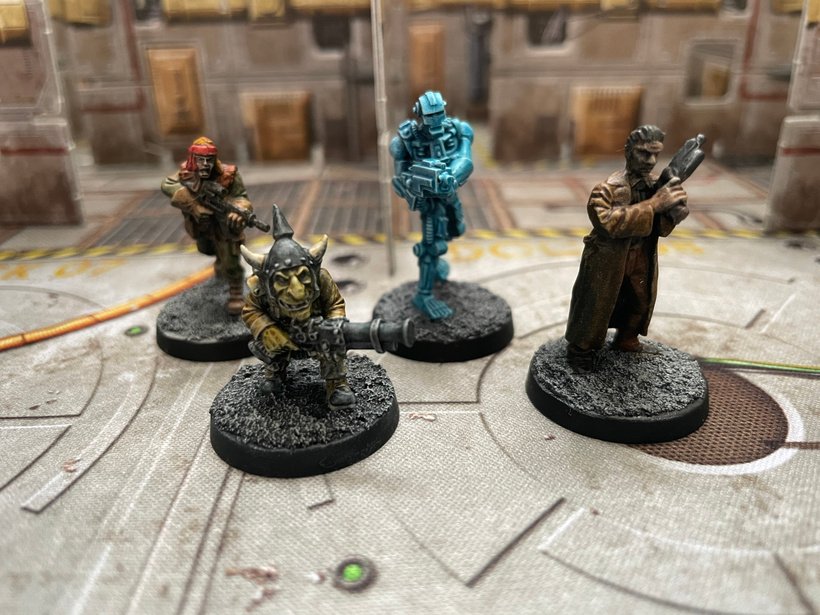
As Dante Corsaro led his gang back towards their ship, Old Reliable, he was accosted by a downtrodden gobbo named Cook, who begged permission to tag along. Cook, by his own account, was the most famous microwave technician on Valtherus. He’d worked in nearly every one of Tin Martian’s now-doomed pubs, and he rightly suspected his career prospects now looked brighter elsewhere.
Cook (front) meets Ruddles, Dust, and Skully
Dante knew all too well that the Strikes were short of the able bodies they’d need to make it off Valtherus alive. Jaryn was being wheeled along by George Ruddles, who definitely doesn’t have a gambling problem. He was nervously chattering away about how he’d managed to get a fiver on the chances of anything coming from Mars at a million to one, just before the local Ladbrokes brought its steel shutters down for the last time.
Tinhead, meanwhile, was currently dismantled and distributed across several Tupperware boxes, a biscuit tin and a couple of Lidl bags.
Taking Cook up on his offer was an easy call. At the very least, they’d eat well tonight. That was, of course, assuming they survived to see it.
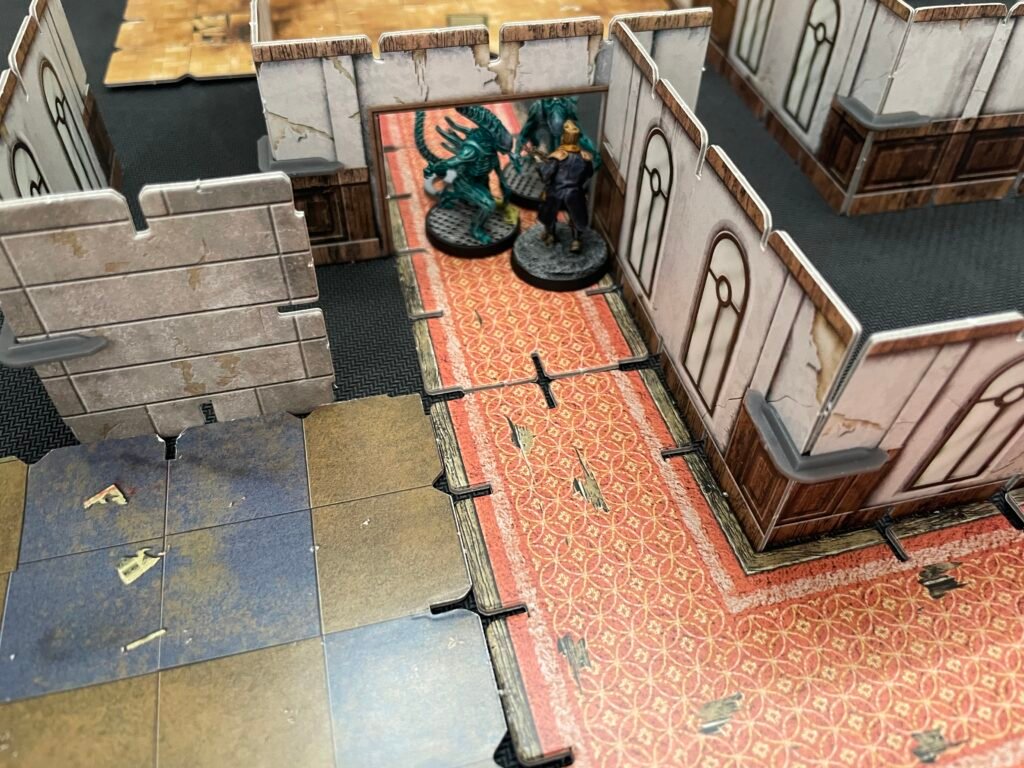
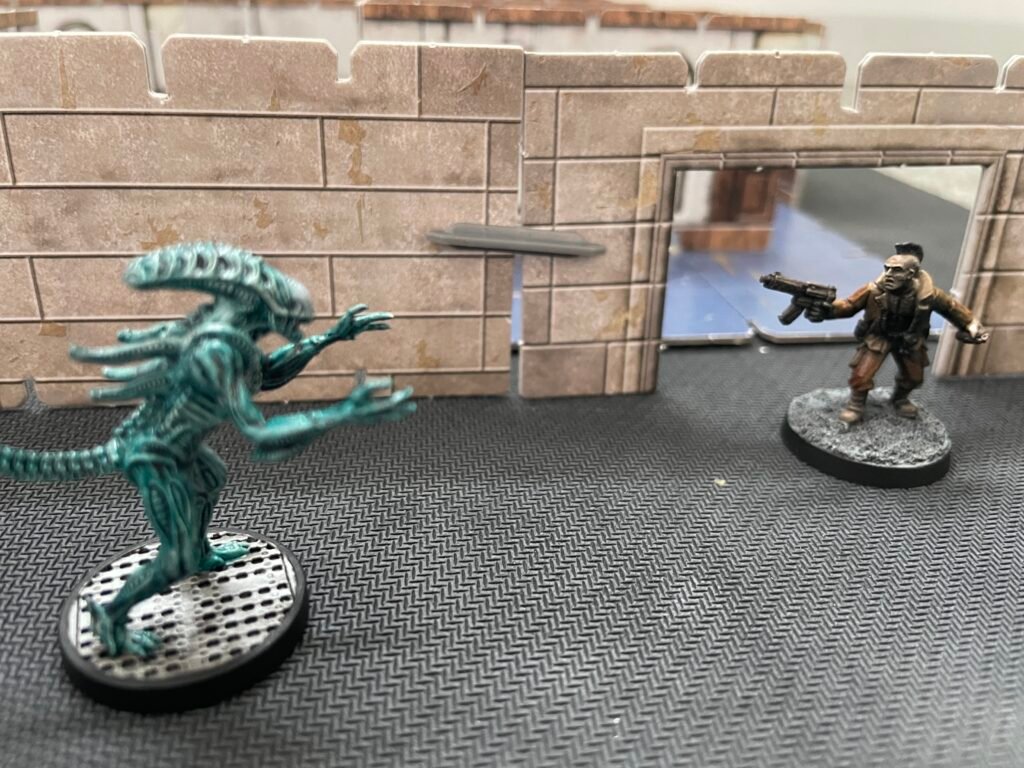
They made it back to Old Reliable in good time, well ahead of the swarm that was clawing and feasting its way through the streets. Jaryn and Tinhead were safely stowed aboard, and the crew stepped back outside to begin their rigorous, Health and Safety Executive-compliant risk assessment pre-flight protocol. Unfortunately, three hours into the process, the brood finally caught up with them, and it would take one more fight to the death before they could board the ship and leave Valtherus behind for good.
Plenty to aim at, but not much success
Swarm’s Eye View
The six able-bodied Strikes were Dust, Tace, Skully, Ruddles, Dante and Cook, the latter borrowing Jaryn’s shotgun for his baptism of fire while Jaryn himself sat this one out in the sick bay, again. They were outnumbered two to one against no fewer than twelve Swarm Brood.
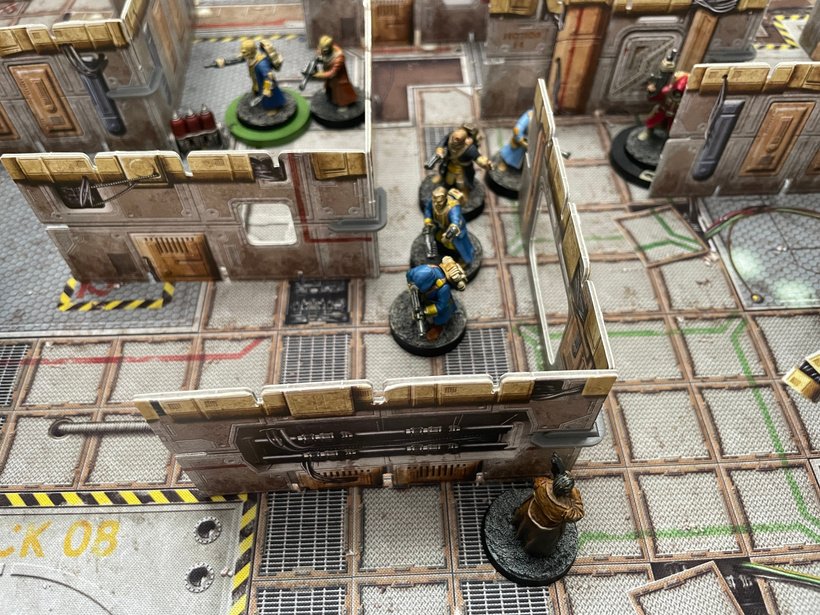
It went badly before it went well. Dante found himself dragged into a brawl, though he dispatched his attacker with the but of his pistol. Tace and Dust did the early damage from range, but for every creature that dropped, another two seemed to take its place, and it wasn’t long before the whole line was overrun.
Dante and Tace are overwhelmed
Dante was the first to fall, swarmed by two at once and finally brought down after taking one of them with him. Ruddles went next, and then Tace, surrounded and beaten into submission after holding his ground for as long as he could. That left Dust, Cook and Skully to finish what six had started, and finish it they did, right down to the last creature, which took Skully with it in one final, mutual exchange.
Twelve dead, and only Dust and Cook still standing to see it.
Butcher’s Bill
There’s no pay, loot or reward for fighting your way off an invaded world, so it was straight into counting the cost. Dante came away with nothing worse than a headache. Tace wasn’t so fortunate, badly hurt enough that he’ll be out of action for a good while yet. Skully didn’t make it, suffering a fate so gruesome that even his infantry laser was smashed to bits. Then came word that George Ruddles hadn’t survived either. Two of the Lucky Strikes, gone in one afternoon. Rest in peace, Skully and Ruddles.
Somewhere in the chaos, a spare med patch went completely unused; one of them might have made it through unscathed with a bit more presence of mind. Lesson noted for next time, probably.
That leaves the roster at six, with Jaryn and Tace both out of action and Tinhead due back on his feet next campaign turn. Valtherus itself remains contested, no surprise given the fight that had just been fought over it.
The crew renegotiated some old debts on the way out, chipping the ship’s balance down to eleven credits, while Dante’s concealed blade picked up a fault of its own, the latest addition to a growing pile of things nobody’s got round to fixing. Filed away for later: a personal trinket that might yet turn up a payday on a future world, a rumour to spend care of some handy local maps, and a certain delivery job that Dante and Jaryn still need to squeeze in – quite literally.
All in all, a brutal round. But now, at least we can regroup and rebuild, right?
Well, not quite…
Uninvited Guests
The battered and bleeding remnants of the Lucky Strikes fight their way onto Old Reliable and seal the doors, only to find the ship being robbed by a gang of opportunistic raiders.
This ragtag band of lowlifes have been hired by a wealthy collector to steal a prized possession of Dante’s: the stubbornly attached lavalier mic used by Maurice Gibb on that infamous episode of The Clive Anderson Show in 1997. Dante won the item in an eBay auction a few years back, but it seems a rival collector has one final bid left in him.
One rare piece of good news: Dante is back on his feet after the swarm brood showdown, and it seems Jaryn had the gumption to bolt Tinhead back together while the battle raged on outside.
The four Strikes members who can still walk face a gang of raiders who’ve been told they’re free to keep anything else they can find. That means everything is at stake here: their credits, their stash, and whatever’s left of their dignity.
Seven raiders, armed with colony rifles, against four remaining crew who’ve barely had time to catch their breath. Everything the Lucky Strikes have left is on the table. Find out how they fare next time.
If you enjoy these Five Parces From Home Diaries, they’re just a brief summary compared to the podcast version you can listen to on the Bedroom Battlefields Patreon.
Turn five opens with a full complement for the first time, seven crew members on the books and two credits of upkeep to keep them fed, watered, and entertained. There’s still cash to spare though, with eight credits going towards the ship’s debt, taking it down to a much healthier sixteen. A couple more credits fund spare parts for Tinhead, who manages to successfully repair a marksman’s rifle.
But not every task goes so smoothly. Dante heads out to explore and ends up in a pub brawl with a staunch Clive Anderson supporter, culminating in the Strikes adding a third rival to the list.
George Ruddles fares even worse, revealing (or denying) a gambling problem that costs the crew an item from the stash. On the plus side, he also picks up a promising tip-off on the 14:30 at Newton Abbott.
Ruddles – “A fiver says they won’t kill us for at least three turns.”
Trading goes better, turning up starship repair parts, spare fuel credits and a set of local maps that might come in handy on a future world. Skully rounds out the turn with a trip to the gym for a spot of experience and a protein shake.
The patron job comes from the corporate patron picked up last time. The danger payroll is a disappointing two credits, must be done this turn, no benefits, no hazards, just demanding conditions. So what’s the story here?
Gibb Me Strength
Dante Corsaro struggled to hide his surprise when the Lucky Strikes’ new corporate patron turned out to be the owners of the most famous theatre on Valtherus.
The source of their trouble, it turns out, is two rival Bee Gees tribute bands, Gibb Me Strength and Les Tossers.
To celebrate Barry Gibb’s birthday – which is a public holiday on Valtherus – the two acts had submitted applications to perform a commemorative concert at the venue. Les Tossers were given the go-ahead, and Gibb Me Strength were furious.
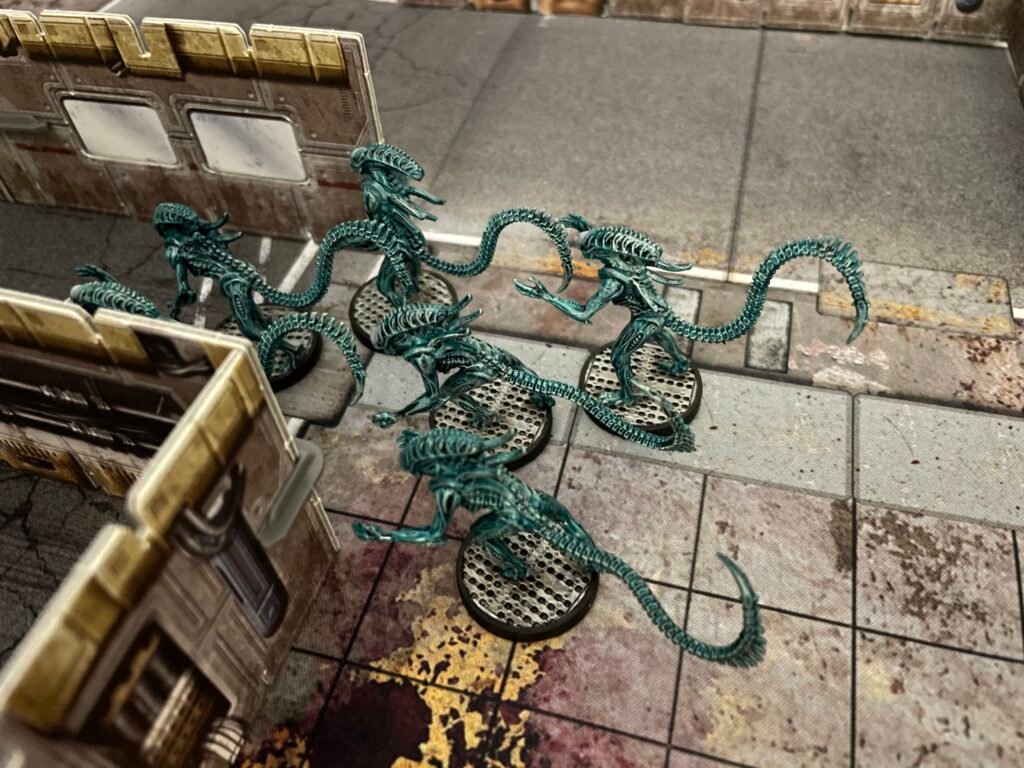
In fact, the spurned trio were so angry that they broke into the theatre’s sub-basement and decanted a nest of swarm brood eggs. Those eggs have since hatched, and their former occupants now stand a full foot taller than your average human.
A tough crowd in the theatre tonight
Unless the theatre management can find someone stupid or desperate enough to go down there and attempt to kill them for money, Les Tossers won’t be performing on Barry Gibb’s birthday. And should any of these lethal aliens escape from the arena’s underbelly, the entire population of Valtherus would be in grave danger.
It’s the Lucky Strikes’ most lethal mission yet. And after a run of relatively good luck, it’s hard to see this ending well for Dante and the lads. They’ll have to kill every single one of them to earn their pay.
And aside from that, it’s all just about Stayin’ Alive.
The Battle
The Strikes just want to get in and out as quickly as possible, and they manage to seize the initiative for the first time in the campaign, though the early shooting is dreadful across the board.
It takes a few turns to do any damage. Jaryn, back from the sick bay, gets a shot at the swarm brood queen and fluffs it, but redeems himself moments later in a brutal exchange that kills the queen even as it takes him down, too.
Jaryn has a spot of bother finding the toilets
As the aliens close to point-blank range, the fighting turns increasingly desperate. Dust falls, Tinhead ends up surrounded and is eventually taken out as well, leaving Tace, Skully and Ruddles to finish the job. It’s Tace who ultimately proves the star of the show, picking off four of the creatures at close range with his machine pistol and finishing the fight virtually single-handedly.
Tace Bruen took down 50% of the swarm brood
Despite three casualties, the crew hold the field and wipes out every last one of the swarm brood.
Post-battle brings six credits from the job and danger pay, plus three more from battlefield scrap. The bad news follows quickly: a roll on the invasion table confirms Valtherus has now been overrun. The crew must attempt to flee the planet next turn, regardless of what else happens.
Injuries prove kinder than expected. Tinhead needs just one turn of repairs, Dust walks away unscathed, though Jaryn is looking at another three turns in the sick bay. Experience points are shared around generously, with Ruddles and Tace both picking up useful skill upgrades. A campaign event even offers up a potential seventh recruit for next time, too.
Turn five closes with eighteen credits, three rivals, three patrons, and a planet crawling with xenomorphs that the Lucky Strikes are more than ready to leave behind.
If you enjoy these Five Parces From Home Diaries, they’re just a brief summary compared to the podcast version you can listen to on the Bedroom Battlefields Patreon.
My plan to celebrate the Tabletop Miniature Hobby Podcast’s fifth birthday was simple. Create an open recording session and invite a handful of legendary former guests to drop in for a chat. Then, when nobody turns up, just sit there and paint a second edition Space Marine in peace.
But my plans were scuppered when Jervis Johnson actually went and turned up. I was about to tell him I had a monopose Space Marine to paint when Andy Chambers dropped in, too. By the time Tuomas Pirinen arrived, my painting ambitions were in tatters. And when Alessio Cavatore pinged up on the screen, I threw my crusty old pot of Goblin Green against the wall in a fit of rage.
Still, there was nothing else for it but to listen to the guys chat and make sure I kept my foot pressed firmly on the ‘record’ pedal. With the recording now cut into a wax cylinder (and made available as an RSS-distributed digital audio file), I’m delighted to present it to you.
In all seriousness, this was a fantastic experience and truly surreal to sit on the digital wall like a large pink fly. I’m unbelievably grateful to Tuomas, Alessio, Jervis, and Andy for giving up some of their valuable time for this humble podcast, and I’ll never tire of listening to any of them. Thanks for everything, chaps!
Subscribe or Follow on Your Podcast App of Choice
The Tabletop Miniature Hobby Podcast is available everywhere podcasts are found.
Turn four opens with the usual admin, a credit for crew upkeep and three more chipping away at the ship’s debt, now down to twenty-three. The bigger news is a new recruit. A story point is spent bringing George Ruddles, the recently liquidated founder of Ruddles Asset Recovery, into the fold as a seventh crew member. It’ll cost an extra credit in upkeep each turn, but with six crew members rarely all available at once, it looks like a fair trade.
New recruit George Ruddles (right), a keen amateur mycologist
Trading continues the crew’s proud tradition of hauling home broken junk, this time a batch of combat drugs somehow ruined in transit. There’s better luck on the repair front though, with the infantry laser fixed up and handed to Skully, and med patches free up Jaryn for another mission.
The Sticky Tables Have Turned
A cloud of synthetic blueberry-scented mist swirls around Dante Corsaro as he draws on his vape and nudges Dust Kallas in the ribs.
“This is the part where he calls them tossers”, chuckles Corsaro, pointing to the grainy footage on his phone.
They’re about to watch Barry Gibb storming off The Clive Anderson Show on the 30th October 1997, when a LinkedIn notification suddenly pops up on his screen.
Dante is shocked to see he’s been tagged in a post by Ruddles Asset Recovery founder and CEO George Ruddles. In this verbose and self-aggrandising post (which was obviously written with the aid of ChatGPT), Ruddles declares it’s “the end of an era” for his business, and that he’s “excited to see what comes next”.
Dante has a message from Ruddles, too. “Any jobs going mate?” asks the former bounty-hunting entrepreneur, devoid of any preamble. Ruddles Asset Recovery, it turns out, folded within hours of the LinkedIn post – Ruddles is, in his own words, “between ventures.”
Dante gazes round the room at his battered and bruised crew, takes another draw on his vape, and gets his thumbs working on a reply.
Two days later, Corsaro and Ruddles sit side by side in a nearby pub, across the table from three half-drunk pints of cheap ale, and a very wealthy prospective patron.
“It’s a shame the government don’t have any more work for you, Corsaro”, says Tin Martian, leaning forwards in his chair. “But I have plenty.”
“It’s time for Doctor Blight to get a house call he won’t forget”, continues the lion-maned licensee.
Dr Blight outside his country manor house
By the time the pints are empty, the deal’s done. George Ruddles has a new job, the Lucky Strikes have a new gun, and Tin Martian’s empty pubs have never felt closer to full.
The mission is Eliminate, with Blight himself not-so-randomly selected as the target, protected by his own hired militia, the ‘Doctor’s Orders’. Deployment conditions leave the crew caught off guard, all acting in the slow phase come round one, a neat bit of irony given they were meant to be catching Blight by surprise. Dante obviously didn’t expect the Doctor to have company.
The Doctor’s Orders defend Blight’s rotting log at all costs
The battle is tense from the start. Blight’s rattle gun stuns Skully early, and a flamer specialist nearly catches Dante and Tace before Dante guns him down first. Ruddles and Jaryn claim a hilltop position, Dante grabs a valuable stash of loot in the open centre ground, and the pressure mounts on Blight’s remaining troops. A dangerous moment arrives when Blight wounds Jaryn twice with the rattle gun, only for two stim packs to keep him standing. Moments later, Dust lands the shot that matters, killing Dr Blight outright.
A comfortable victory looks assured until a stray shot drops Dante at the very last moment. Jaryn finishes the job, cleaning up the last of the militia and securing the win, but it’s a damp way to end a mission that had gone almost entirely to plan.
The rewards are the best the crew has seen yet, thirteen credits between mission pay, danger money and loot, plus a frag vest and a lead on a new corporate patron.
Dante, meanwhile, should be dead. An eleven on the injury table spells death outright, saved only by his last remaining luck point!
Turn four closes with twenty-two credits, three patrons, two rivals, two story points, and a captain who’s used up his last stroke of good fortune.
If you enjoy these Five Parces From Home Diaries, they’re just a brief summary compared to the podcast version you can listen to on the Bedroom Battlefields Patreon.
Still on Valtherus, and still finding plenty of reasons to stick around, turn three opens with a bit of housekeeping. A credit goes on crew upkeep, two more chip away at the ship’s debt, and four credits fund repairs to get Tinhead back on his feet before the next fight.
With Colt gone, the crew can recruit a free replacement without any tests or rolls. Enter Skully, a new face with a grudge of his own, more on that shortly.
New recruit Skully – scourge of TripAdvisor
Trading, as ever, produces a haul of almost entirely broken equipment, including a mysterious ‘hot shot’ pack nobody’s had the chance to identify yet. Jaryn, still recovering in the sick bay, gets a bonus action thanks to a strong roll from the previous turn and heads out to socialise, though he fails to turn the resulting chat into a story point. No matter, there are story points to spare this turn: one sold for three credits, one spent boosting Jaryn’s combat skill to a respectable three, and one more spent giving Dante a second task. That last one sends him out exploring, where he picks up a rather unfortunate side gig as a drug mule for a future delivery job.
And speaking of jobs…
The Valtherian sector government has just declared its seventeenth pandemic of the year – nothing to do with Dr Blight, as always, according to the man himself, who has already released a statement condemning “baseless android conspiracy theories.”
Amid the chaos, the government has offered the Lucky Strikes an urgent contract to assist with outbreak management. This is the kind of job nobody sane volunteers for, which makes the Strikes exactly qualified.
But they won’t get the chance. While the crew are grounded at Cinderdock – a sagging, half-condemned patch of tarmac that generously calls itself a spaceport – Ruddles Asset Recovery tracks them down and hits them while they’re enjoying a few beers and listening to Barry Gibb’s 1984 solo album, New Voyager.
The Strikes are, on balance, fine with this. Their last encounter with Ruddles Asset Recovery cost them a crewmate: Colt Narro, shot dead during the Sludge Basin job. Captain Dante Corsaro had planned to pay these goons a visit soon anyway, so he’s more than happy to have them come round to his place.
The Lucky Strikes prepare to host Ruddles Asset Recovery
Colt’s replacement is a new recruit calling himself Skully, who reached out to the Lucky Strikes after the Sludge Basin job, thanking them for getting one over on Ruddles Asset Recovery. Turns out Skully has been getting bothered by them ever since he left one of Tin Martian’s pubs a bad review on TripAdvisor. Now, he’ll have the opportunity to review these bounty hunters – through the scope of his gun.
A toxic environment condition raises the stakes, any crew member left stunned risks becoming a casualty outright. The battle opens badly, Dust is shot down almost immediately, but Tinhead evens the score by taking out the enemy lieutenant. Momentum swings back and forth, Tinhead falls too, and Skully is stunned and forced to roll against the toxic air, passing by the skin of his teeth. Eventually the Lucky Strikes claw their way to victory, closing the fight in melee.
Post-battle, RAR finally have enough and drop off the rivals list, though the failed government contract costs the crew that patron in return. Both Tinhead and Dust, despite being shot down, walk away with barely a scratch. Loot includes a useful ship parts discount and a personal trinket, while Skully earns a little extra cash on the side during his debut, along with the crew’s respect.
Turn three ends on fifteen credits, two patrons, two rivals, and three story points, the healthiest the Lucky Strikes have looked so far. It probably won’t last.
If you enjoy these Five Parces From Home Diaries, they’re just a brief summary compared to the podcast version you can listen to on the Bedroom Battlefields Patreon.
Getting off Frenavos was never optional, and turn two opens with Old Reliable burning six credits in fuel just to relocate. There’s a brief scare when Tinhead, still smitten with the last planet, needs a story point spent to drag him aboard, though a lucky “time to reflect” roll hands that point straight back. No harm done.
The new destination is Valtherus, a world with no licence requirement and a thriving bot manufacturing scene, meaning cheaper upgrades for Tinhead down the line. Both rivals from Frenavos follow the crew here, Directive Zero among them, so the heat is far from off.
With Tinhead, Jaryn and Tace all still out of action, only three crew members are fit for tasks. Dante volunteers himself as a decoy to throw off the pursuing rivals, while Dust and Colt head out looking for patrons and strike gold, turning up not one but two. The standout is a job from the Valtherian sector government, and thanks to Dante’s decoy trick, the rivals fail to track the crew down, clearing the way to take it on.
The Job
The owner of a popular chain of budget pubs on Valtherus has blamed a recent spate of plagues on the government’s chief epidemiologist, Dr Septimus Blight.
Tin Martian, “the Android Alehouse Keeper,” claims Blight isn’t curing the plagues – he’s causing them, and in doing so has devastated the planet’s once-booming hospitality industry.
Dr Septimus Blight and Friends
Though these allegations have been vehemently denied by the Valtherian government, Tin Martian may finally have found his smoking gun. The flustered Dr Blight recently left a briefcase of important documents in a particularly unpleasant area the locals refer to as “the Sludge Basin.”
It is unclear what business Blight had in the Sludge Basin, though he has since claimed it’s part of his role as patron of a sick rats’ charity.
Martian has hired the notorious Ruddles Asset Recovery Corporation to obtain the briefcase from the toxic sump. The Valtherian government haven’t been so lucky in their quest to hire anyone stupid enough to accompany Blight back down there to retrieve his property. In the end, they’ve had to put their faith in a beleaguered gang of fugitives called the Lucky Strikes. Or what’s left of them, anyway.
So will it be last orders for Dr Blight, or can the Lucky Strikes get him safely into a taxi before it all kicks off outside the chippy?
Colt Narro (left) was the first of the gang to die
The mission type is Protect, escorting the unarmed Dr Blight to the centre of the table. With only three crew fit to fight against five bounty hunters, the odds look grim, but the plan holds: Dante draws fire in the middle while Dust and Colt work the flanks. Dante proves surprisingly handy in a brawl with his duelling pistol, dropping the enemy lieutenant, while Dust picks off their specialist with a lucky rifle shot.
Ruddles Asset Recovery
It’s not without cost. Colt, drawn out of cover chasing two bounty hunters, is gunned down. But Blight reaches the centre of the table, grabs his briefcase, and holds it long enough to win the mission. Dante finishes the fight in style, throwing a concealed blade to finish off the stunned specialist.
Aftermath
The post-battle sequence brings mixed news. Ruddles Asset Recovery, humiliated, becomes a third rival, but the Valtherian sector government signs on as a patron in return. Sadly, Colt doesn’t survive his wounds, the campaign’s first proper casualty, though his death opens a free recruitment slot for the next turn. Dante and Dust both pick up enough experience to improve their combat skills.
Turn two closes with eleven credits, three patrons, three rivals, and a growing sense that this world isn’t done with the Lucky Strikes yet. Rest in peace, Colt.
If you enjoy these Five Parces From Home Diaries, they’re just a brief summary compared to the podcast version you can listen to on the Bedroom Battlefields Patreon.